Search This Blog

Showing posts with label winter rye. Show all posts

Thursday, March 4, 2021

Spring prepping has begun....

After a cold beginning, the temps rose quite rapidly yesterday once the sun rose into the beautiful blue sky. That's been a rare occurence around here lately. And, wanting to take advantage of this event, I decided to go out and get a head start on the many things I need to do. It will be time to start planting soon enough and one cannot waste a day like this.

So, my first decision was to move my veritical support poles to accomodate the cucumbers and tomatoes. I will once again employ the spring loaded string system I used last year. I had to move the poles about a foot in order to get them centrally located so I can plant a row of cukes and maters alternately down the row. This will allow me to use the rest of the bed for other plants. Haven't quite decided but I am thinking in terms of cooler weather crops. Maybe even carrots. I am hoping this will create a wall of green. I think it would look beautiful. Here are a couple pics of the supports.
Thumb of 2021-03-03/grdnguru/470fdbThumb of 2021-03-03/grdnguru/c026ab
The holes were 2 feet deep as they will need to carry a lot of weight. I can only hope it will work as envisioned.
After setting the poles in place, I decided to begin the process of cutting down the winter rye down so it can begin to break down into the soil. I used a grass trimmer to do this as I only wanted to cut the rye halfway down. It didn't take long and wow, the scent of freshly cut grass permeated the whole garden and beyond. I can probably say I was the first to cut grass in my community. My neighbors might say something different. It was a really nice scent that furthered my desire for spring to pop.
Here is a before and after comparison.
Thumb of 2021-03-03/grdnguru/21753b
Thumb of 2021-03-03/grdnguru/c41689
Again, I did not want to cut it down to the soil as that would result in both bleaching and a runoff (during rains) of the nutrients out of the soil. I want to feed it a little at a time. I will probably turn the rye totally under towards the third week of March. There are many ways to use rye as some gardeners/farmers cut the rye and use it as composting materials. Others let it decompose where it lays. Farmers, from what I can tell, cut the rye and leave the cuttings in place and allow the roots to breakdown in the ground. I use a spade or fork to just dig them up but not move them. I just lift up a little to allow air in to dry the roots. It seems to work so I will probably do that this year.
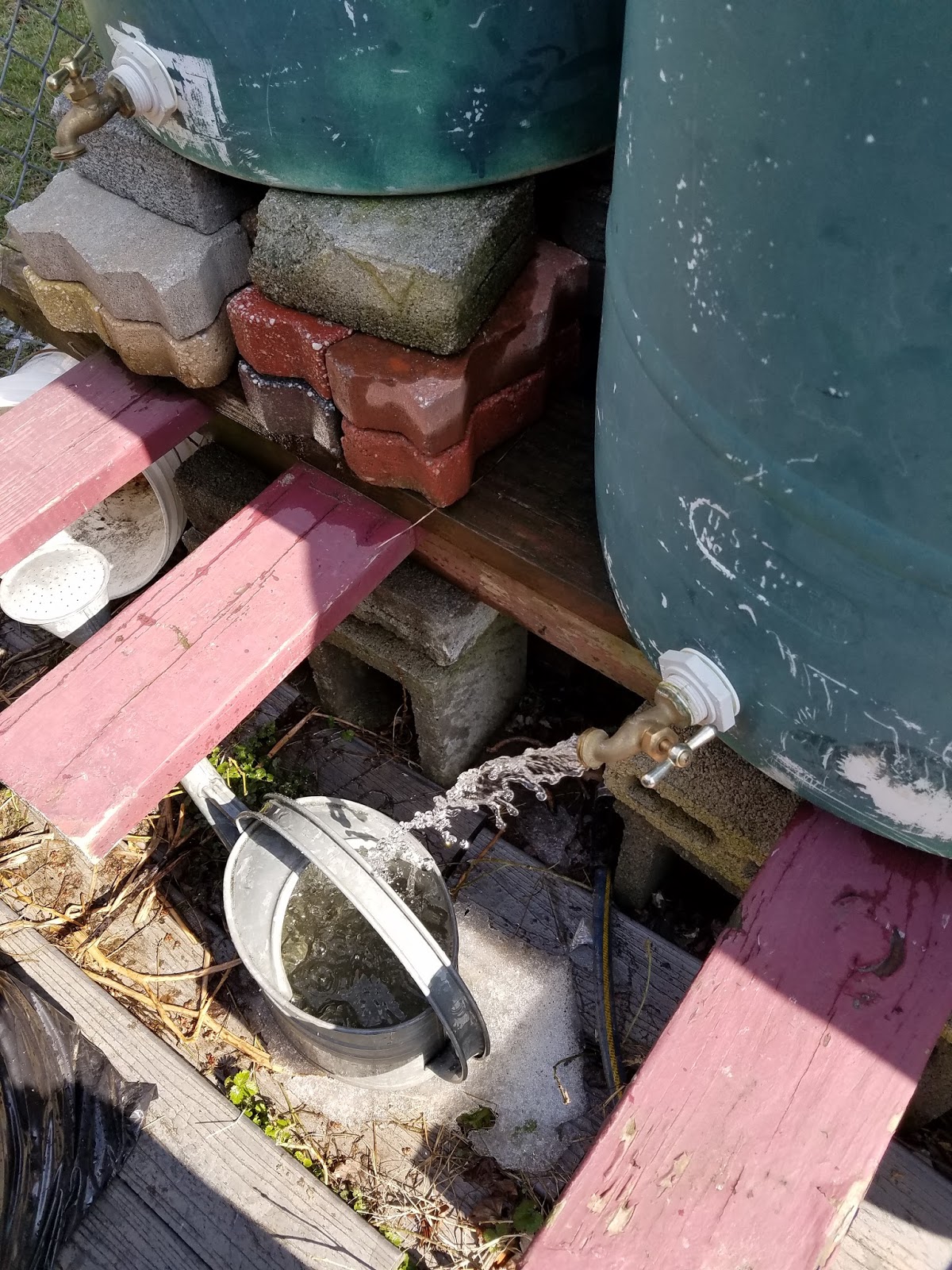
After doing these tasks, I cleaned up the garden area as winter has taken its' usual toll. I worked in the greenhouse for a bit to just get it ready for the seedlings which will need to be transferred to it in the coming weeks. I did check on my water container since it rained buckets over the weekend clear into Monday morning. Seems it was heavier than I thought.
Thumb of 2021-03-03/grdnguru/79ccfc
This is about 250 gallons of water. I can't remember having this good of a supply so early in the year. Considering that on February 26th, I had maybe, 90 gallons, this storm gave me about 150-160 gallons. That's a ton of water. I use the water mostly for the garden. But, I have been known to bucket water to clean our cars. It's chemical free so it has to be better than water from the faucet. The only issue is if it gets horribly warm, algae growths occur. I use a shock for pools which burns off in 1-3 days after application. I use the faucet when that occurs.
Well, that's about all I have at this time. Still much to do and I will be reporting on the seedlings that are growing in my basement in a subsequent post. I hope you are all getting back into the rythm of Spring. I think we all need it after everything that has happened. Nothing like working with plants and dirt to connect you to the earth. So, until next time, Happy Gardening everyone!

Sunday, March 10, 2019

Weather issues

It's been awhile since I last posted.  That is because I have been fighting a very tenacious cold that just won't go away.  Just seems to have the ability to linger on - mostly through a cough.  But I figured it was time to check in so here we go.
Lots going on actually around the area.  Spring has taken leave so Winter has been the dominant feature of the weather.  We had temps hit lows in the teens and actually had a "snow" event this past week.  Today, Sunday the 10th, was probably the mildest day we have had in awhile.  Temps have been in the 50"s today and we're supposed to see a general trend of warming for the coming week.  All good news indeed as I need to get the garden rolling.
I have recently been adding vegetable scraps to my composters(pictured below) to try to get them reignited with micro biological activity.  Each of them have had about two sets of scraps put in them.  I will wait until we get more consistent weather then I will begin adding more mass to them.


They are about 1/2 full each with seasoned compost ready to use once the temps moderate. I will have to prepare my three beds first by cutting and working in the winter rye that is currently growing in them.  Here is one of the beds I have.  The Rye grew well despite the colder temps we have had.


I will wait for about a week or more before I begin the process of cutting the rye down to begin working it into the soil.  The reason I am waiting is that we are possibly going to have yet another set of colder days around the 21st through the 23rd.  I am trying to let the Rye grow as much as possible in order to maximize the input into the soils.  One week of good temps has often added and inch or more in the past.  
Well, next week, weather and health permitting, I will begin diving in big time into the gardens.  Till then, have a great gardening week!


Sunday, February 17, 2019

Time to begin?

That's a tough question to answer.  The weather is at times saying yes and then cruelly, no.  We are currently at 43 degrees right now.  I walked out to my garden plots and the when I dug into the soil, it was cold and wet.  Not a big surprise as the weather has been quite seasonal.
So, what can be done given the soils are not ready for planting even the hardiest of seeds.  My answer is quite simple.  I will begin the process of clearing out my plastic greenhouse.  I placed one of my remote thermometers in it to get a gauge of what the temperature ranges are at this time.  Once the coldest temps are consistently above freezing, I will then set up the various hydroponic systems I have and  begin seeding in the early crops.  I was behind the curve the last time I planted in it and the crops bolted before I could get a decent crop produced due to too much summer heat.  It's a delicate balance to get the seeds in at the right time.  One season is not like the other in this area. 
I did a little cleaning around the beds when I was outside Saturday morning.  The rains and snows took a little toll on the them.  Nothing huge as everything looks to have come through the winter.  The winter rye is in a sort of dormant state but that will change with a few more weeks of 50 degree weather.  It will be soon enough before I have to cut the rye and start working it into the soil.
I also eyed up the area where I will be building the glass greenhouse this spring.  Lots to do there so I just need to start chipping away at that in small chunks.  The next step is to remove the bricks and paver stones in the area of the greenhouse floor.
Once those are removed, I can then use the rototiller to break up the ground where I will be starting the base of the unit.  That won't be for a little while yet as the ground is wet and we are expecting some freezing temps in the near future.
I took out some kitchen scraps this afternoon and buried them in the unfinished composter.  I did this in order to get the processes moving to create bacteria once the temps moderate.  There will be slow decomposition for now and even that is fine.  It was deep enough to perhaps awaken or feed the existing microbes that exist that far down.   
It was nice to get out in the yards and tool around the various points to get the gardening juices flowing again.  Spring is about a month or so away but hope has been rekindled.  It should be an interesting year given my focus on making the garden contribute to our household.  There is  big difference between gardening as a hobby and gardening to augment our food supply.  We shall see how it turns out.  It is a challenge for sure.  So, there is where the gardening progress is at this point in the year.  Till next time, Happy gardening everyone!

Sunday, January 14, 2018

Beginning of another year

Here's hoping that you had a wonderful New Years and this year is your most productive one yet.  As we inch into the new gardening season, one has to take stock of where you are in order to guide your efforts to an even more glorious harvest.  For me, this year, that means many things.
First off, I have decided to forego my ususal routine of growing most of my own vegetables from seed.  I have decided to purchase most of my plants from two or three growers in my immediate area.  My reasoning for growing my own plants was that the growers were not offering the plant selections I liked to grow.  There was a paucity of heirloom plants available and an overabundance of the usual hybrid varieties.  For me, there is nothing like the taste of the heirlooms.
After visiting the various plant sellers throughout last year, I noticed that between three of the them, I could find almost all of the varieties I wanted.  And, to make it all the better, they were at very affordable prices.  It appears that the growers have finally caught up to me and other gardeners in regards to the superiority of taste of the heirlooms.
I still do need to take stock of my seed inventory which I will complete this week.  An indirect result of the aforementioned decision to curtailing my growing efforts will be a much smaller seed stock and, of course, less purchasing.  I just need to be sure I have the seeds for the various plants that can be started directly in the garden.
All of this will allow me the luxury, if you will, to concentrate more efforts in building my soils to peak richness.  Last fall I planted winter rye in all three of my beds to overwinter them.  I have written several times last year about the benefits of this which I firmly believe in.  The beds are in great shape given the weather we have had recenlty.  Two weeks ago we had wind chills in the negative 10 degree range and have just entered another colder than normal period this week.  It's supposed to right itself by this coming Friday.
Here are the beds as of last week.  I think they look great and the rye is actually holding up much better than I would have anticipated.
               

I will be waiting until probably late February to cut the rye down to the soil level.  Then I will wait for the cuttings to rot for about a week or two.  Once rotted, I will work them into the soil with either a fork or a light roto-tilling.  The object is not to distrub the roots or the sub soils.  This serves many purposes.  The cuttings will act as an immediate green manure, the roots as nutrients for the plants over the growing season as they break down and the light rototilling will not introduce imbedded weed seeds to the sun and warmth required for them to grow.
After I do this, I will need to add a mix of composted horse manure and compost in order to build the necessary fertility and structure in the soil.  One has to be careful to be sure that the manure does not have wood chips or shavings in it as those are detrimental to vegetable growth.  People sometimes use cow manure but that is courting disaster with pathogens if it is not composted correctly.  My choice is to use the safer horse manure.  I will be researching various local suppliers of this as I like to stay as local as possible.
I also have a new 8X6 greenhouse to place in my gardens.  Not quite sure where but my guess is at the end of my beds at the southernmost end.  This will, by proxy, be a reason to reset my beds.  I am thinking of getting rid of my blocks and do a more intensive planting scheme.  I am still playing with various alternatives so I havent really come to any hard choice although I will need to do so in a short time.
Well, that's all the news in the gardens at this time.  Just begining to piece it all together one step at a time.  So, until next time, Happy Gardening to everyone!       

Wednesday, September 20, 2017

Winter Rye seedings.

A true sign that summer is gone is when I begin actually seeding my beds with Winter Rye.  I have been doing this for about 4 years now since I read an article about it on the Rodale Institutes' web site.  October is about the furthest you can push the summer growing season in my area.  In fact, it seems like this year that summer is going to close out early.  Temperatures are leveling off and we have started to see nighttime lows that are beginning to get into the upper 50's.  I don't doubt that we will have a period of Indian summer still to come but, in the final analysis, most of my plants have given their last production at this time. 
I have cleared out all my lettuces, beans and cucumber plants recently.  This week, weather and work permitting, I am going to thin out my non-producing tomatoes and pepper plants.  By the end of next week, all the plants will be removed and thrown in the composters along with my last bag of last years leaves.  Yes, I still had some left.  These will continue to compost through the winter albeit at a slower rate than during the peak summer season.  Once they are all removed, I will seed all the areas with the rye I bought this past weekend from Meyers' Seeds here in Baltimore.
The Rye should continue to grow up until the first hard frost we get.  My experience is that even with a hard frost, they will continue to grow but at a much slower rate.  And, when the weather turns in the spring, they come back to life and begin to grow at their earlier rates.  This gives you excellent green manure when you cut the grass down in the early spring.  You just cut it like grass and let it rot in place.  I will get into more detail on this next year when the time comes.
The goal right now is to get as thick and lush of a seeding in of the rye as possible.  It may take a couple of seedings but if your seed is new, it may take only one time.  I have the other two gardens I help with to seed in for the winter also.  So, it's going to get a bit busy in the next couple weeks but it's all good.    
After these beds are seeded in, I will start to concentrate on growing plants inside my two structures that I have.  I will write about those at length in my next post.  So, for now, that's all there is to report.  Until then, Happy organic gardening everyone!      

Sunday, March 19, 2017

Tomatoes!!!

I started 16 tomatoes from seed this past Wednesday.  I used the Jiffy seed pellet system you can find at almost any home improvement store and maybe a few grocery stores.  Having never used them before, there was a little intrepidation on my part.  So, I followed their instructions and set my seed in each moistened pelet and covered them with the supplied lid.  It made a mini greenhouse that held the moisture in.  I placed the greenhouse on top of our refrigerator and let them sit there until Friday night.
At that point, there was only one packet that had shown a shoot coming up out of it.  I decided to put them into a warming greenhouse seed starter to give them heat to help along the process.  I have had that system for probably 8 years so far.  So, I put them into the warming tray without the top and filled the warmer bed with water on Friday night.  As can be seen from the picture below, there was great progress made over the weekend.


There are 15 of 16 pellets that have plants growing from them.  Given there are various types of tomaotes here, I am pretty sure all will be showing growth within the next day or so.  Now, I have to put these under light in order to allow them the necessary light to grow.  I will wait another day or so then transfer the set of these to the lights.  They will need lots of light - approximately 12-14 hours a day.
I started another set of 18 paste tomatoes and another set of 6 mixed variety tomaotes last night. They can be seen in the backround of the picture above.  My plan is to also begin pepper plants once the tomatoes are moved under light so I can use the warmer for them.  One thing at a time.
It may seem that 40 tomatoes are a lot and I have to admit, it is.  Last year I had 3 paste tomato plants and the they gave an uneven harvest so I am hoping the 18 will give us enough to put up in the fall.  I have never done that before so hopefully we will get the harvest we need and we can learn how to put them up for winter use.
On another note, I went out to check on the state of my little salad garden I have had over the winter. Much to my surprise, they came through the snow and cold temps with great result.  As can been below, all the plants are still healthy at this point.  Even the mesclun lettuce in the lower right corner looked ok and is showing sings of producing a second set of lettuce.
We have had several salads from this bed over the last few weeks.  I'll continue to water and see if we can get pehaps another salad or two before I dig it up for the sping.  I was able to get water from my now three filled 55 gallon water barrels.
The water was cold but it was clean.  And, it's free!  I usually dont have my barrels up and running this early but last year, we had tons of rain until the end of May then pratically nothing.  So, I decided to set them up and we have had several long rainy days so now, they are full.
Another item of interest for me and hopefully you is that my winter rye has taken off quite well this Spring.  As you will notice, it has grown a lot since the last time I looked at it.
It's a lot thicker and taller than my last visit which means I will have more green manure than I anticipated I would have had at this point.  Credit the unusually warm weather and a lack of aprreciable sonwfall.  Not really sure I should be happy about that given the beneficial effects cold weather and snow have on the pest populations around here.  But, I will take what God gives.
That's all I have at this time.  The new season is getting underway and that makes a gardening nut like myself very happy.  Until next time, Happy Gardening everyone.

Sunday, January 17, 2016

2016

Simple enough of a heading, eh?  2016 - a new year and a new garden.  I usually make this long list of plants I want to grow and come up with plans on how I want to grow them and where I will place them in my three beds.  This year - not so much.  Veggie gardening is actually quite simple so I have no idea why I have complicated it so much.
See, you as the gardener have to master the basics.  The vegetables have to do all the hard work. After all, they are the ones out in the elements that must endure pests, fungus's and good old mother nature and all she brings to bear.  So. you have to really be great at the basics.  And the most basic of all items is your soil.  A good soil will bear good plants and a great soil will bear great plants.  I believe a plant derives much of it's strength and resiliency from the soil it resides in.  That's why two neighbors can and often do, get widely different results.
Soil can be tricky for sure.  I'm not sure I have the best soil I can get but I do believe I am moving in the right direction.  Last year was the third year I planted a cover crop.  I can't say enough about cover crops.  My plants last year were much more vibrant and certainly more productive.  I never gave away so many tomatoes as I did last year.  I am going to have to rethink how many of them I am going to grow this year.
My soil is the result of several organic practices that I have adhered to over the last 5 years.  It takes time to develop an organic based soil.  It's been a long time since I used any types of chemicals on my plants.  That was my first step and it had pain associated with it.  When I first started, I lost some plants to wilt and other diseases.  Painful as that was, I can now say that I haven't seen that type of loss in my gardens for the last 3 or so years.
Having gone through that, the goal now is to enrich the soil with the nutrients and structure that will support the plants through almost anything that can be thrown at it.  It sounds like a scary proposition but, in reality, it isn't.  One of the many gifts of doing a cover crop is that when you cut the plants down, you are leaving the root structure of the Rye in place in the soil.  Those roots add a certain framework for the plants to burrow around and establish deep and firm roots themselves.  They also retain existing Nitrogen that is in the soil, meaning that the nitrogen will be available in the spring to your crops.  Without the rye, nitrogen will leach to varying degrees from the soil over winter.  As the roots of the cover crop roots decay over the summer, they slowly release nutrients to the soil and thereby the roots of the new plants resulting in more vibrant and productive plants.  It has been very noticeable over the last two years to both me and my neighbors.
It's mid January now and the cold of winter has taken hold in the mid-Atlantic region.  I have done my seed inventory and determined what seeds I definitely don't need to buy to augment my gardening this year.  There are some I need but I can wait for the time being.  One thing I will do in the next week is seek a source of organic manure.  While I don't use a significant amount of it, I feel that it is a good augmentation of my compost and peat moss that I use throughout the summer season.
There really isn't a abundance of things you can do in the garden if you aren't growing winter vegetables now.  I need to prepare my tools and I also need to clear the area where I start and grow my seeds. My wife and I went to a well known garden supply store here in Baltimore yesterday that is curtailing their garden operations.  I was able to get some structures from them that I intend to use in my garden  although I haven't quite worked out how yet.  We shall see.
Well, that's all for now.  Until next time, happy gardening everyone!


Friday, December 25, 2015

Awww... the 70's in December

What do you do when you are supposed to be in the dormant period of your gardening but the weather is acting like it's late fall?  That question came to me today as we reached the low 70's today.  Yes, it was 70 degrees on Christmas day here in Baltimore.  I walked out to take a quick survey of the garden between downpours and I must say that the winter rye crop has grown quite a bit since we started this unusual run of warmer weather.  I am not complaining mind you.  The extra rye will help in the spring.  But who would have thought we'd be in the 70's at this time of the year.  Crazy eh?
I began mentally listing what I could do with the time I have off from work.  Usually, I have stopped most of my work and am looking over my seed stock to see what - if any - seeds I need to get to be ready for early March.  But, given the extra bonus period of nice weather, seeds are the last thing I will be spending my time looking at this weekend.
The first thing I am going to do is walk my garden to see if I need to do any maintenance and general pick up around it.  It was a crazy fall so I think I may have left a few things to Spring.  Guess I'll get to that now.  Cleanup would be a top priority.  I have some leaves from last year that I should probably throw in the couple of composters I have since they are still actively working.  That would also clear up the area behind my garage and set it up for next year.
The second thing I am going to do is remove any leaves remaining in the beds so that I can just cut the rye in the early spring.  That will give me a leg up on the whole process.  Not a bad bonus considering it's winter.  At least I guess it's winter.
And the third thing I am going to do is get my weeder out to trim the grass around the bed borders. The grass has been growing the last couple of weeks.  That has resulted in a blush of growth around the borders which looks unsightly and is a possible source of bacterial growth in the spring.  If I leave the grass and probably embedded weeds to the Spring, the first cut I do of them will broadcast weed seed and any bacteria in them into the garden beds.  If I cut them now, the cold of winter will kill off the bacteria and probably most of the weed seeds too.  So, my choice is to address the issue now when I can let nature do the dirty work for me.  Always a plus.
Given that the forecast is for intermittent rain tomorrow, I will have to pick and choose times to get these completed.  But, get them done I must.  If you have a garden that is currently laying dormant, you too may want to consider doing a few maintenance items to save yourself time in the spring.  If you have any questions, please feel free to leave a comment and I will respond as soon as possible.  Here's hoping you had a wonderful Christmas.  Until next time, Happy Gardening!      

Sunday, October 11, 2015

One week later

It's been a week since I started the winter rye in my two established beds.  The weather was mainly dry so I had to augment mother nature.  I took a look at the beds on Wednesday and there was no signs of life.  I have to admit that I was a little concerned in that I really hadn't had the time to water the beds heavily.  Life does get busy at times and this week was no exception.  I watered them with a heavier soaking Wednesday and followed with a lighter soaking on Thursday.  There were still no signs of life on Thursday evening so I began to think that I would have to seed the beds again.  That is, until Friday night when I came home from work.
While there wasn't a huge amount of growth, when I was watering the garden I saw the beginnings some growth.  I watered the beds in the face of a severe thunderstorm warning Friday evening.  My wife thought I was a little odd in doing this even though there were very dark clouds rolling in from the west.  I watered enough to get the top of the beds wet.  It poured here Friday evening and I was again questioning my choice to water the beds.  I mean, did I over do it?
I went out to the garden this afternoon and the pictures below show what I discovered.


The picture to the left is the one week old seedlings in one of my established beds.  The one on the right is from the two week old seeding I did in my new bed.   It's hard to see the seeding's with a picture, but it won't be long before they look like the ones in the right picture.  They will get maybe two to three feet tall, all depending on the weather.  It tolerates lower temps so hopefully it will stay a little moderate for the upcoming month or so.  I will let mother nature take over at this time only watching the weather to maybe augment some watering.  This is how you grow your own green manure and limit the amounts weeds you will have in the spring.  Plus you don't have to worry about carbon leeching as the roots of the rye will fix the nitrogen in your soil over the winter.  It also reduces damage to your soil that occurs in winter such as erosion or pest infestations.
Well, that's all I have for today.  If you have a question, please feel free to leave a comment.  Until next time, Happy Gardening!

Sunday, October 4, 2015

Sunday, busy Sunday

I woke up this Sunday morning with nothing really in mind.  Due to a change in my plans, I decided that since Joachin was a bust here in Baltimore, that it would be a great cool day to shut down both of my beds for winter.  That entailed harvesting the final tomatoes and peppers for the year in those beds.  After clearing out the plants, I then raked the beds and cleared out the few weeds that were in the beds.  Then I seeded in the winter rye.
As discussed in my prior post, using winter rye as a cover crop for winter is becoming more accepted by farmers and gardeners alike.  I have found it to be very useful and have seen an increase in the yields over the three years I have been doing this.  There are numerous advantages to doing this.
I follow the same routine every year.  I will detail that here.  Below are pictures showing the progression to get one of my beds ready for rye.


The picture on the left is the beginning condition of the bed.  On the right, it shows the result of pulling the plants and tilling with a tine rake to clear all the debris and weeds from the bed.  Once you get the bed to this condition, you can then seed in the rye seed.  I use a hand spreader as pictured below.
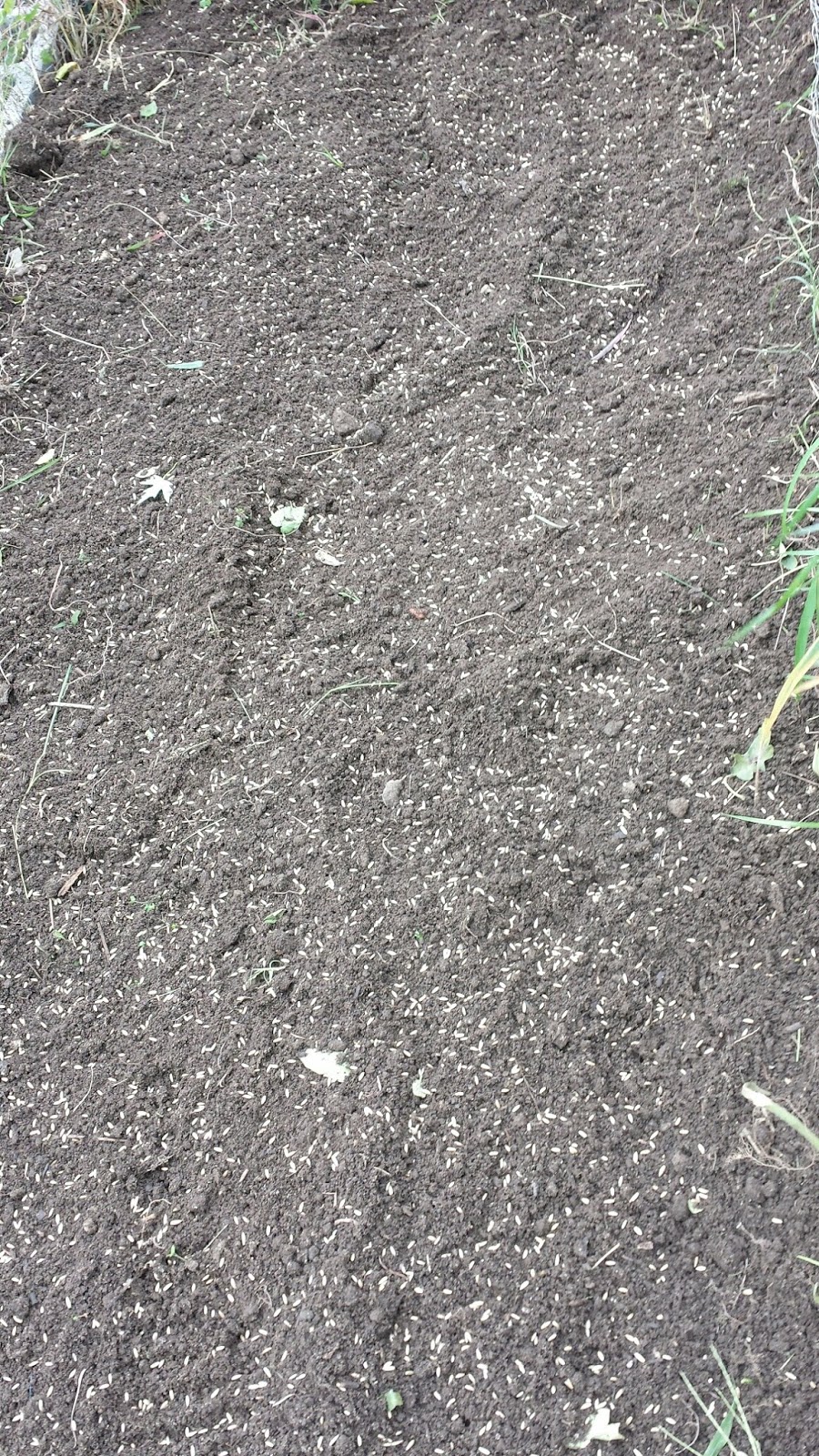
This helps to evenly spread the seeds to reduce the number of bare spaces in the beds.  The result should look like the picture below.

Once you spread the seed, I suggest you should lightly tamp the seed into the soil using a tine rake in order to make sure the seed is in contact with the soil.  It should look like the picture below.  Again, you would lightly tamp them in.  All you want is for the seed to be pressed into the soil.
                                                                                                                                                                    After this is completed, I go one step further.  I would encourage you to cover the seed with peat moss.  I do this for multiple reasons here.  We have a big bird population here which would mean they would easily find and eat enough seed to wipe out a fair portion of what I sowed.  Secondly, unlike other covers such as straw or a bird mesh, the peat moss does not need to be cleaned or taken off the seeds.  It becomes part of your soil.  Peat moss also keeps the soil moist between your watering.  Below are two pictures showing the peat moss as I progressed.


The picture to the left shows half of the bed being covered to give you the contrast between what it started out as and what it should look like after application.  The right picture shows the completed bed.  I make sure as many seeds as possible are covered so as not to attract the birds.  
Once you have all the seeds covered as best as possible, you will then lightly water the beds to wet the seeds.  After you have done this, you need, as in all seed applications, to insure that the beds do not dry out.  One hint I have is to watch the weather and if you can, plant the rye when there is an expected period of rain in the near future.  I have done this a few times and it seems that nature is much better at watering than I am.  I get my best results when I am able to time it in this fashion.
Well, that's about all I have for today.  I will update my rye planting as it develops.
Until then, happy gardening everyone.