Search This Blog

Showing posts with label peppers. Show all posts

Friday, March 19, 2021

Sown and growing

 The weather here has turned backed to normal. It is seasonably cool here now. We got a bit complacent last week as we hit the 70's for three days straight. But, that hasn't stopped the clock either. There is much to do as I say and time keeps on ticking. I hear it loud and clear.

I line with that, I have been seeding in the various Spring vegetables that I need this year. I especially like to grow my own plants to allow me to have varieties of plants that I want. Choice is a wonderful thing in most cases. One other point is that seedlings from the various stores are amazingly expensive as I have seen tomato plants at about $4.00 each. You could spend a small fortune if you have a garden of any size and not get best tasting veggies.
So, here is one set of what I call my "mix". It is made up of Parsley, Cabbage, Broccoli and Onions. They are about 2 weeks old as of today.
Thumb of 2021-03-16/grdnguru/a615c4
Then I have another planter of spinach which is also about 2 weeks old too.
Thumb of 2021-03-16/grdnguru/1db0fc
I have also planted Tomatoes, Cucumbers and Peppers in another planter. Since this was done about 3 days ago, there aren't any seedling yet. I have them on a heat mat and covered with a plastic dome. I did see one cucumber seedling poking through so it should be anytime now for the rest of the plants to pop up - or not. I plant more seeds than I need plants because there are failures in every seeding.
Thumb of 2021-03-16/grdnguru/ab9f98
Right now, this is about all I can do until the soils outside warm up a bit. And, if the forecasts are to be believed, it may get even colder towards the end of this month. The seasons are changing as we go through what I have heard of as a solar minimum sun cycle. Whatever is happening, our weather has been different in many ways so one has to adapt to them.
I did get out yesterday to stake out my onion beds which should be planted very shortly. I have structures to cover the area so that probably will be what I do. Here is how I staked the area. I will plant the onion sets I have at 9 per square foot. If that ends up in overcrowding, I will pull some of the onions to allow more space. But, if I get 9 per square foot, that will result in 288 onions. This is my first year with onions and I bought a pound of yellow onions. I may not have 288 but I will plant as many as I can/need. I am also considering planting one block and see where that takes me. I have some decisions to make so that will be a moment of planting situation.
Thumb of 2021-03-16/grdnguru/c680d8
The planting season is getting underway pretty quickly. There is a lot to do and I have been getting steadily busier as each week passes. There may be a few time lapses in my writing but rest assured, I will write. So, until the next opportunity, Happy Gardening Everyone!

Saturday, June 10, 2017

Where the gardens are today(Part1)

I have been fortunate enough to be given the opportunity to assist two other gardeners in my area with setting up new garden areas for them.  I say fortunate because it is a compliment of sorts to have people ask you for advice let alone trust you to plan and implement their gardens.  It has been quite busy time maintaining my garden while working with these folks on their gardens all the while holding down a job too.  But it is very rewarding too.
My gardens' activity has been pretty hectic to date.  I expanded the garden area and made several decisions to make the garden more productive with food we enjoy eating and also to allow for foods that can be put up in the fall.
Last year I planted 4 paste tomatoes thinking I'd get enough from them to put up a few jars worth in the fall.  Just to try it out.  It was, to say the least, a huge disappointment.  I have spoken to several gardeners who all related that their tomatoes were off last year.  So this year, I bought 20 paste plants thinking an area of 81 sq. ft would be enough.  Not quite as it turned out.  Given last years crop issues, I did some research and found out that I have actually been crowding my tomatoes.  Seems the ideal spacing is 2 ft. between plants in a row and 3ft. between each row of caged plants.  So, I spaced mine so that I could get 15 plants in the isolated area where they wouldn't be impacted by any other plants issues.  Here's a picture of the plot so far.

The large boards on either end of the rows are set up so that I can tie them up in what is called the Florida weave method.  I have never used it before but decided it lookd easier (in the long run that is) than staking and/or caging the plants.  I do not like the cages that are sold everywhere as they are much too low height wise to handle plants that can grow to 6-8 ft. tall.  I never really understood why they were always manufactured to such small heights.  May have to do with the thin wire they use to construct them.  
The Florida weave method entails running a string alternately around the plants at 10 - 12 inches from the soil line and then every 10-12 inches upwards to give them the support they need.  Here is a picture of my first attempt at it.
You start at one end and weave the string on opposite sides of the plants as you go down the row and then loop back and weave the string to the other side of each plant.  This kind of cradles the plant as can be seen in the picture. When they get to 2 ft height, I will then do the weave at that height.  This will continue until they reach full height.  I am by no means an expert so this will be an experiment. We have had some windy weather and the plants seem to have had no issues yet.  
On another tomato note, I have 10 plants of various hybrid and heirloom plants in the ground that all seem to be doing very well too.  After researching why I had so few tomatoes last year, I learned thateither the hybrid tomatoes or heirlooms seem to do well each year but one always outperforms the other type.  As I had predominately heirlooms last year, that may have been the source of my issue. So, this year, I have it almost split down the middle.        

The two plants in the bowls are for my father in law for Father's day.  He used to have a garden but has given it up for various reasons.  I will put a cage around them for additional support.  I will use a mix of the cages I have and poles for support once they overgrow the cages.   All he has to do is water them at this point.
Speaking of experiments.  Last fall I grew out lettuce and carrots in a covered mini greenhouse.  The carrots are still growing and I have replanted the lettuce to see if I could continue to grow using the structure.  Here is where it is at as of now. 
I have two rows of leaf lettuce that are growing quite well.  I continue to water the plants and need to pull some of the carrots to see if progress is being made or we are at a standstill.  But, to have leaf lettuce this far into the season is a bonus.  
I planted a row of Buttercrunch lettuce about a month ago and covered it under woven vegetable fabric.  As can be seen below, it also is doing very well given the lateness of the season.
There are 7 heads of the lettuce in the row and they seem to all be growing very strong.  We're going to be having some nice salads soon enough.  
I also have a bed of 16 Bell Pepper plants that are doing ok given our decidely cooler weather we have been experiencing.  They are all healthy as can be seen in the picture below.  I love peppers but I really do think I over grew yet again this year.  I will probably end up giving some (alot actually) if they come in like last year.  We shall see how that turns out.  

I've also planted 6 cucumber plants.  I have them trellised on my DIY structures.  A local garden center closed about 2 years ago and I bought their onion set displays.  Here is how they ended up looking in place after I painted them and added screening.

They are really sturdy, wind resistant and somewhat compact.  When I bought them, my wife was skeptical as was I.  But, the cucumbers are starting to grow to a point where they are climbiming unto the screening.  I will see how they fare as they climb.
In the backround of the same picture are three interconnected wire "ladders" that I have converted to yet more cucumber trellises.  These were repurposed from being protective coverings for plate glass windows that were being delivered to the company where I work.  I wired them together and then attached them to rebar I pounded into the ground. they held up 5 cucumber plants - cucumbers and all through some windy storms.  These were being thrown out so I asked for them and was told if I can get them in my car - they were mine.  And they were.
With the weather turning much warmer in the next week, the various plants should begin to become more robust.  I will have to naturally watch them as the higher temps can cause issues.  You may leave in the morning and come home to plants wilting right before your eyes.  Don't stress!  This is natural as the plants wilt to preserve moisture to survive.  Just give them a good drink of water and watch them rebound.  It doesn't appear to cause any long term damage.  But if this happens repeatedly, that's mother nature telling you that you need to step up your watering game.
So, there you have the latest, greatest from my backyard.  In part 2, I will recap what has been happening in one of the gardens that I am assisting the people into becoming full on gardeners.  I will give all the details in the next week or earlier.  Until next time, Happy Gardening everyone!!!!   

Sunday, August 28, 2016

Pre-season Fall gardening preparations.

Yes, it is almost that time of the season again.  Yesterday was absolutely a beautiful day so I decided to take advantage and do some preps early.  I cleaned out my bed that has protection for when the weather takes a change in course.  So, I pulled the few weeds there were and decided it was time to add some of compost for nutrient enrichment.
I pulled several shovel fulls of compost and screen sifted them so that I wouldn't have any unfinished compost in my beds.  Here is a picture of before and after compost to show you the reason for the sifting.  The compost in the wood bin is unsifted and  you can certainly see the difference in the compost in the wheel barrel bed.


Then, after sifting several loads, I unloaded it into the bed where I am going to attempt to grow the winter crops.  This is probably about ten shovel fulls of sifted dirt.


I then spread it out to even the bed out.  I will let it now sit and work its way into the soil beneath it.


So, I will water this area a few times to allow for the compost to release the nutrients deeper into the soil.  That, in turn will supply the plants I put in there with the nutrients at their root level.

All the while I was doing this, I was being closely watched by our neighbors super inquisitive dog Meg.  I don't mind a bit.  She's really a sweet dog.  Hopefully she is picking up some pointers.


While I was doing all these preps, I noticed there were several cucumbers and a lot of new pepper blooms.  I watered the area around noon yesterday and followed with another soaking in the evening. A ritual that I always follow with no bad results.  
So, this morning, I went out to the garden and picked the cucumbers.  Can't believe all the cucumbers and peppers I am getting this year.  And no, I am not complaining.   


We will be enjoying these over the next few days.  There is nothing like eating fresh vegetables you have grown from seed to what you see.  Very satisfying indeed.  Well, that's all for now.  Hope you are having a great season.  Happy Gardening everyone!

Sunday, August 7, 2016

Sunday in the garden.

Like any gardener, I spent a fair portion of my morning in the garden.  Yesterday was absolutely hot and humid.  I tried to endure the heat but when I checked the weather on my phone and it was 90 degrees with a feel like 98.  Now, I like to garden, but it just seemed pretty illogical to continue to fight the elements.  So I stopped even trying to get stuff done in the garden.  And for me, that's a very hard task to do.  I don't like missing a day in the garden, especially a weekend day. 
So, I just resolved to get up early today and knock some things out. 
First priority was to pick some veggies.  I watered the veggies last night so they would be firm.  That's something I have always done and it seems to work very well.  I picked Peppers, tomatoes and cucumbers.  All favorites of my family.  As you can see, there was a good amount of fruit available. 


The one large cucumber was the result of the vine travelling into the pepper plot unseen.  I did not see that one until this morning so it matured to a larger size than I normally pick them at.  I will eat it but when they get to that size, they begin to become overrun with larger seeds inside.  The quality is diminished for sure.  But like I said, I will eat it nonetheless.  After all, it's a cucumber. 
The big tomato on the bottom second from the left is a Cherokee Purple.  That's an heirloom which can grow tomatoes up to about a pound or better.  And the taste is almost as good as my favorite heirloom - Brandywine.
My wife made me a cucumber/tomato mixed salad for dinner tonight.  I can say this, there is absolutely nothing as great tasting than fresh garden tomatoes and cucumbers with my favorite dressing.  No store bought - even local sourced tomatoes and cucumbers - can even come close.
On another note, as I mentioned in my last post, I have decided to renovate my garden to give it more structure and better production.  Well, that process has now begun.  As seen below, I have removed the first set of bricks at the back of my one bed.  I measured the area to make sure I wasn't reducing my beds and when all was measured, turns out the area will be a bit larger.  Seems I will have an extra 4 square feet per bed.  All good news. 


 So, there you have a day in the life of my garden.  Hope you enjoyed your day as much as I did.  Until next time, Happy Gardening everyone.       


Sunday, June 19, 2016

Mid Point Review

I know tomorrow is the first day of Summer officially, but if you have a garden, it's the mid-way point of the growing season.  And, it's also that time of the year when the garden needs the most attention.  On this Fathers' day, I took inventory of where my garden is and what I needed to do to continue or improve the garden.
As we are heading into the heat of the summer here in Baltimore, I decided I needed to have a back up system for watering - a hose.  I usually hand water with rain water I store in rainbarrels but inevitably, I get too busy at times and may put off the watering given the 100 degree heat we have here.  So I set up a hose and a sprinkler as shown below.


Notice the state of the art equipment I am using.  This is a Rain King rotary sprinkler commonly found in the 60's and 70's.  But it does a great job and it was dirt cheap to buy at an antique store.
And it works!
Here is my patch of 14 Pepper plants.  All looking healthy at this time.  These represent two successive plantings.  Don't need many of them but they are easy to freeze and great tasting to bring out in the Winter.
I also have 8 Cucumber plants that are just starting to grow up the trellises I made from various items I have scrapped over the years.  I another month or so, the trellises will be a flush of green.  Just need to keep training them up and they will do the bulk of the work on their own.
Next I have about 60 bean plants in various states of growth.  I have planted them successively for the last 5 weeks which should insure a constant crop over the next couple months.  
Then finally, I have my 14 Tomato plants of various types.  The summer heat will bring with it rapid growth over the next month or so.  As you can see from the one picture, there are buds galore on some of the various early type tomatoes.


So, all in all, and compared to my neighbors and what I am hearing from various gardeners I know, my garden looks productive.  I'll have to keep an eye on it of course and do the things that will keep the momentum going, but that's all in the nature of having a garden.  Till next time, Happy and productive gardening everyone.


Sunday, October 4, 2015

Sunday, busy Sunday

I woke up this Sunday morning with nothing really in mind.  Due to a change in my plans, I decided that since Joachin was a bust here in Baltimore, that it would be a great cool day to shut down both of my beds for winter.  That entailed harvesting the final tomatoes and peppers for the year in those beds.  After clearing out the plants, I then raked the beds and cleared out the few weeds that were in the beds.  Then I seeded in the winter rye.
As discussed in my prior post, using winter rye as a cover crop for winter is becoming more accepted by farmers and gardeners alike.  I have found it to be very useful and have seen an increase in the yields over the three years I have been doing this.  There are numerous advantages to doing this.
I follow the same routine every year.  I will detail that here.  Below are pictures showing the progression to get one of my beds ready for rye.


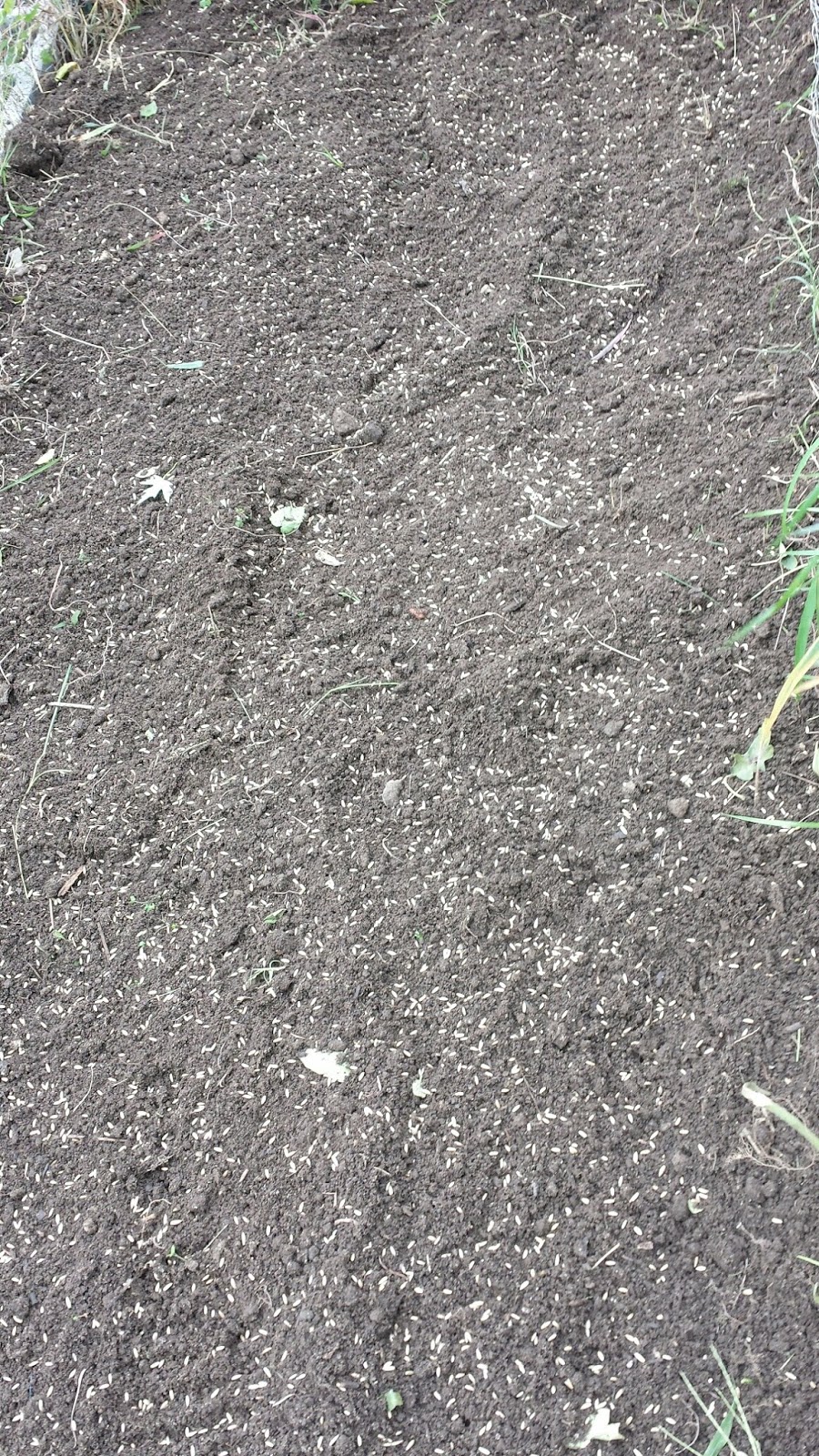
The picture on the left is the beginning condition of the bed.  On the right, it shows the result of pulling the plants and tilling with a tine rake to clear all the debris and weeds from the bed.  Once you get the bed to this condition, you can then seed in the rye seed.  I use a hand spreader as pictured below.
This helps to evenly spread the seeds to reduce the number of bare spaces in the beds.  The result should look like the picture below.

Once you spread the seed, I suggest you should lightly tamp the seed into the soil using a tine rake in order to make sure the seed is in contact with the soil.  It should look like the picture below.  Again, you would lightly tamp them in.  All you want is for the seed to be pressed into the soil.
                                                                                                                                                                    After this is completed, I go one step further.  I would encourage you to cover the seed with peat moss.  I do this for multiple reasons here.  We have a big bird population here which would mean they would easily find and eat enough seed to wipe out a fair portion of what I sowed.  Secondly, unlike other covers such as straw or a bird mesh, the peat moss does not need to be cleaned or taken off the seeds.  It becomes part of your soil.  Peat moss also keeps the soil moist between your watering.  Below are two pictures showing the peat moss as I progressed.


The picture to the left shows half of the bed being covered to give you the contrast between what it started out as and what it should look like after application.  The right picture shows the completed bed.  I make sure as many seeds as possible are covered so as not to attract the birds.  
Once you have all the seeds covered as best as possible, you will then lightly water the beds to wet the seeds.  After you have done this, you need, as in all seed applications, to insure that the beds do not dry out.  One hint I have is to watch the weather and if you can, plant the rye when there is an expected period of rain in the near future.  I have done this a few times and it seems that nature is much better at watering than I am.  I get my best results when I am able to time it in this fashion.
Well, that's about all I have for today.  I will update my rye planting as it develops.
Until then, happy gardening everyone.  


Sunday, July 5, 2015

Early July musings

After partaking in the usual festivities of the July 4th weekend, I woke up this morning to pick my first batch of green beans in the early morning hours of a calm, quiet Sunday morning.  Of course, my trusty companion Barkley meandered along with me as we made our way out to the garden. I think he was expecting some kind of treat but it was not meant to be.  It was the first set of beans for this season which reminded me that I needed to plant some more seeds for future crops.  There is nothing that can even begin to describe the taste of fresh picked green beans.  I mean, just look at this scad of beans I picked this morning.


Don't those look great?  Can't wait to eat them as these are so far superior in taste to that which you will find in any grocery store.  I didn't plant a ton of these but rather have spread them out over several weeks by planting about 18 seeds every week.  That way, they don't lose their taste.  

On another note, I am getting ready to pick a bunch of Bell Boy and California Wonder Peppers in the next couple of days.  I took a picture of one Cal Wonder just to show the quality you can get in the garden.  


And, in further proof that I am succeeding(I think) in my organic quest, while perusing the garden this afternoon, I found a guest that I never would have thought I would have seen.  Take a look. 


I am no expert, but logic tells me a frog would not be in my garden if I were using pesticides and such in it.  The tiny creature surprised me as he just hopped out from under one of the pepper plants and stayed still while I went about my business.  I can't really remember seeing a frog in my garden before so I will take that as a sign things are going in the right direction in my organic quest.  Frogs, for the most part, are very good to have in the garden as they eat insects by the bunches.  Now, with that being said, they aren't that selective either and thus can eat beneficial insects too.  Most of my experience says they are good for the garden so I am very happy to oblige this little visitor.  Who knows, he may stay.   
Well, that's all for now.  If you have any questions or concerns regarding your garden space, let me know as I would be glad to assist you with your needs or issues.  Until then, happy gardening everyone!